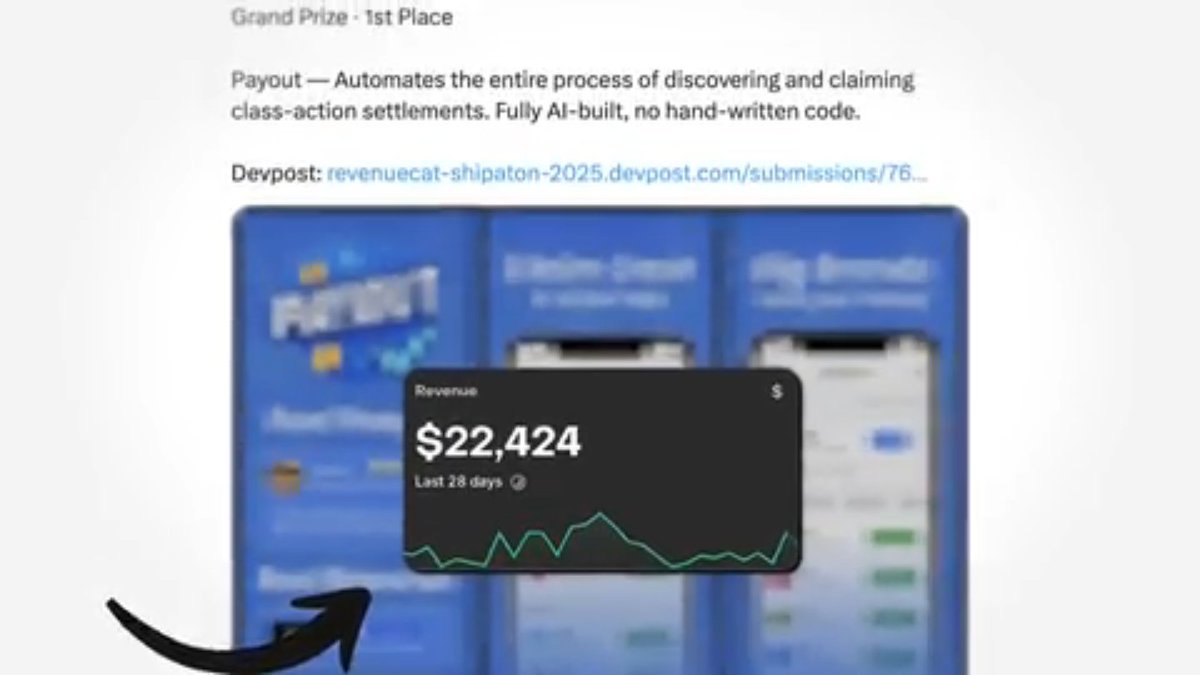
The post reports that Payout used AI to build an app for finding and claiming class-action settlements in roughly two weeks, acquired users through paid Facebook ads and reached about $80,000 MRR.
A 23-year-old built an app with AI in 14 days. Four months later, it was making ~$80,000 a month. The app is called Payout. And the idea is almost stupidly simple. It helps people discover class-action settlements they may qualify for — and claim the money. Connor Burd didn't spend a year building it. He didn't hire a large engineering team. He used AI to compress what he says used to take him 6–8 months of development into roughly two weeks. Then he launched. The app reached roughly $20K/month early on. A few months later, RevenueCat reported it at around: $80,000 MRR. That's nearly a $1M annualized run rate from an app built in 14 days. � Yahoo Finance +1 But here's the part most “make money with AI” posts leave out: AI wasn't the business. Connor didn't ask AI to invent some revolutionary new market. He found something people already wanted: money they were entitled to but didn't know how to find. AI simply made it dramatically cheaper and faster to turn that problem into software. And after the product existed, he still needed distribution. His growth strategy relied heavily on paid Facebook ads. � Yahoo Finance That's probably the biggest AI business opportunity right now. Not: “How can I make money with AI?” But: “What already makes money that AI now lets one person build?” That is a much more valuable question.
Uses Higgsfield for Airbnb photo and walkthrough packages, pitching free samples before a paid bundle; a second offer finds businesses in Meta’s Ad Library and proposes 12 ads for $2,000 monthly.
A Claude skill produces science and mystery Shorts with scripts, visuals, narration and captions; Zapier uploads them to YouTube, connecting production with channel monetization.
Uses Claude Code for animation, editing and motion graphics in a new YouTube channel, reviewing the creator’s 14-day experiment from publishing to monetization.
Use a revenue agent to review old proposals, emails and customer activity for follow-up opportunities, with humans closing deals; Morgan also sells training and setup services around her agent methods.
Compares AI files, PDFs, shopping Shorts, SaaS and website work, emphasizing how templates, custom development and workflow services become products or client orders.
Creates vertical dramas with Kling 4.0, planning keyframes and consistent characters through references, then calculates episode costs to assess commercial production.
Finds brands, makes an AI UGC sample for a product and uses outreach to sell finished ads; the creator proposes up to $500 per ad and uses Zapier for email replies.
Presents lead-response agents, AI copywriting and ecommerce stores as starting options tied to customer acquisition, marketing deliverables and product sales.
Targets seasonal audiences such as Christmas-music listeners, creates original AI music and YouTube videos, and builds a consistent channel toward Partner Program income.
Uses Claude to analyze competitors’ Meta ads and Higgsfield to create brand visuals, pitches with Loom over LinkedIn and proposes a $2,000 monthly creative retainer.
Uses ChatGPT business-idea and outbound-list skills to define a one-person offer and identify prospects, turning after-work time into customer acquisition and service setup.
Creates ebooks and iPad planners with Claude, sells through Gumroad and Topmate to Indian and US buyers, and tests Instagram, Pinterest and Meta ads for acquisition.
Finds designers, clinics and other businesses through Google Maps and Instagram, researches them with Claude, builds sites with Hostinger and pitches the finished websites.
Explores AI video production as a YouTube-channel business and provides topic-finding and finished-video resources, connecting niche research with publishing.
Uses Claude Code with a Higgsfield connector to accelerate video production, reducing repetitive editing for small YouTube creators so they can focus on content and channel growth.
Uses Claude and Higgsfield to analyze reference shots and make brand samples, then emails agencies and production studios with a portfolio; the creator reports a $2,000 production order.
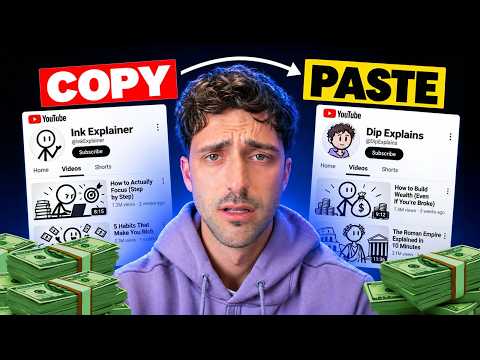
Uses ChatGPT Astra and Higgsfield to produce stick-figure animations at scale, turning scripts into repeatable YouTube output for a channel that needs no on-camera host.